
 Retour
Interview with the Honourable Malcolm Rowe
In this episode of Shaping Canada: 150 Years of Landmark Decisions, we have an exclusive conversation with the Honourable Malcolm Rowe, appointed to the Supreme Court in 2016 as the first justice from Newfoundland and Labrador. With an unconventional path that included roles as a procedural advisor, Foreign Service Officer, and architect of Canada's "Turbot War" strategy, Justice Rowe brings a unique perspective on the practical consequences of judicial decisions. He explains the doctrine of stare decisis, the vital line between private life and state intervention, how the Court adapts to societal change while maintaining stability, and why the Secession Reference represents "a master class in the Canadian Constitution."
Entretien avec l'honorable Malcolm Rowe
Dans cet épisode de Façonner le Canada : 150 ans de décisions de principe, nous avons une conversation exclusive avec l'honorable Malcolm Rowe, nommé à la Cour suprême en 2016 en tant que premier juge originaire de Terre-Neuve-et-Labrador. Fort d'un parcours atypique ayant compris des rôles de conseiller en matière de procédure, d'agent du service extérieur et d'architecte de la stratégie canadienne de la « guerre du turbot », le juge Rowe apporte une perspective unique sur les conséquences pratiques des décisions judiciaires. Il explique la doctrine du stare decisis, la ligne cruciale entre la vie privée et l'intervention de l'État, la manière dont la Cour s'adapte au changement social tout en maintenant la stabilité, et les raisons pour lesquelles le Renvoi sur la sécession constitue « une leçon magistrale sur la Constitution canadienne ».
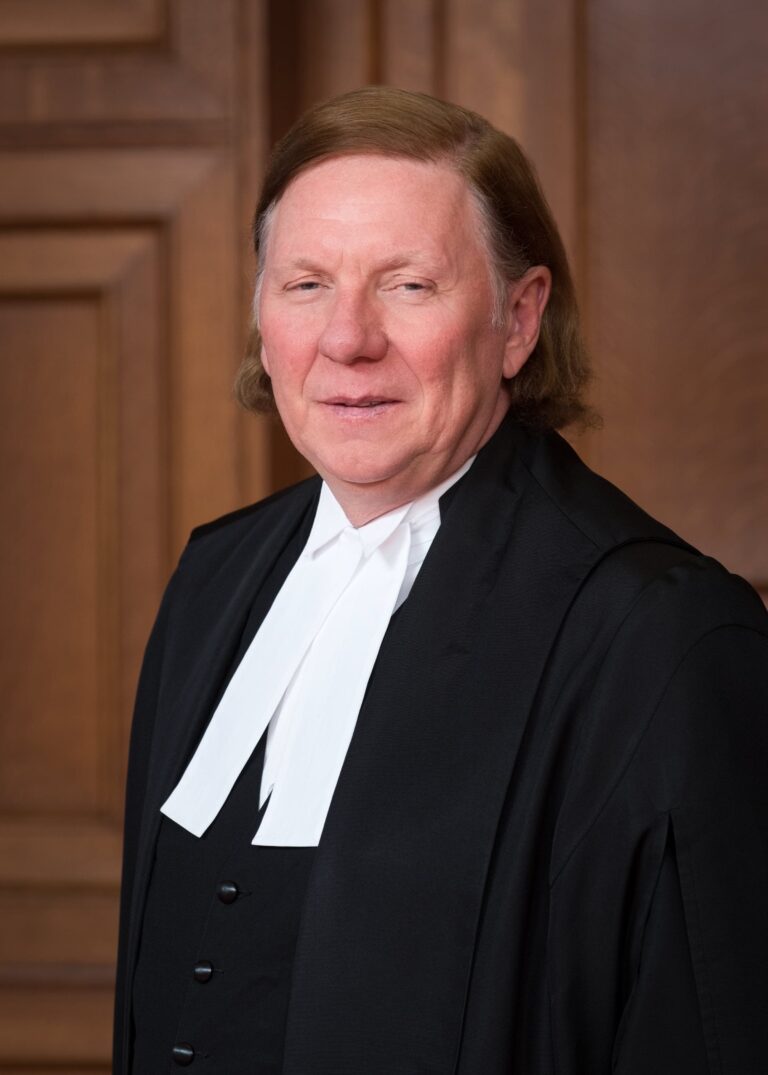
The Honourable Malcolm Rowe, Justice of the Supreme Court of Canada
Supreme Court of Canada — appointed 2016
Malcolm Rowe was appointed to the Supreme Court of Canada in 2016, becoming the first justice from Newfoundland and Labrador to sit on Canada's highest court. Justice Rowe's path to the bench was unconventional — he estimates that approximately 40% of his career was spent in non-legal roles. He began as a procedural advisor in Newfoundland's House of Assembly, then served as a Foreign Service Officer before entering private practice.
His pre-judicial career placed him at the centre of major national and international issues. He was deeply involved in arbitrating the maritime boundary between Canada and Saint-Pierre and Miquelon. Under Fisheries Minister Brian Tobin, he formulated the strategy for the "Turbot War," blending international law with dramatic enforcement action. He also played an instrumental role in the constitutional amendment that created a secular public school system in Newfoundland.
Before his appointment to the Supreme Court, Justice Rowe served on the Supreme Court of Newfoundland and Labrador (Trial Division) and the Court of Appeal of Newfoundland and Labrador. He is known for his expertise in public law, constitutional matters, administrative law, and international law, drawing on his practical experience in government to understand the consequences of judicial decisions on state institutions.
L'honorable Malcolm Rowe, juge à la Cour suprême du Canada
Cour suprême du Canada — nommé en 2016
Malcolm Rowe a été nommé à la Cour suprême du Canada en 2016, devenant ainsi le premier juge originaire de Terre-Neuve-et-Labrador à siéger au sein de la plus haute juridiction du Canada. Le parcours du juge Rowe menant au banc a été atypique — il estime qu'environ 40 % de sa carrière s'est déroulée dans des rôles non juridiques. Il a débuté comme conseiller en matière de procédure à la Chambre d'assemblée de Terre-Neuve, puis a servi comme agent du service extérieur avant d'entrer en pratique privée.
Sa carrière antérieure à sa nomination l'a placé au cœur d'importants enjeux nationaux et internationaux. Il a été profondément impliqué dans l'arbitrage de la frontière maritime entre le Canada et Saint-Pierre-et-Miquelon. Sous la direction du ministre des Pêches Brian Tobin, il a formulé la stratégie de la « guerre du turbot », combinant le droit international et des mesures d'application spectaculaires. Il a également joué un rôle déterminant dans la modification constitutionnelle qui a créé un système d'enseignement public laïque à Terre-Neuve.
Avant sa nomination à la Cour suprême, le juge Rowe a siégé à la Cour suprême de Terre-Neuve-et-Labrador (Division de première instance) et à la Cour d'appel de Terre-Neuve-et-Labrador. Il est reconnu pour son expertise en droit public, en questions constitutionnelles, en droit administratif et en droit international, s'appuyant sur son expérience pratique au sein du gouvernement pour comprendre les conséquences des décisions judiciaires sur les institutions de l'État.
Contenu
Un parcours atypique, un atout sur le banc
Cette expérience hors des salles d'audience — arbitrage international, stratégie gouvernementale, réforme constitutionnelle — n'est pas restée en retrait de son travail de juge. Elle éclaire directement, dit-il, la façon dont il aborde les affaires de droit public qui se présentent maintenant à la Cour.
Les conséquences pratiques des décisions judiciaires
« Les juges doivent toujours être conscients des conséquences pratiques. Cela fait partie de notre rôle », explique le juge Rowe. Son expérience au sein du gouvernement lui permet de « tracer une ligne directe entre le type de décisions que prennent les juges et les conséquences pour tous les autres acteurs et institutions de la structure politique du pays ». Lorsqu'on lui demande si ses collègues recherchent ses éclairages pratiques, il rétorque par un trait d'esprit : « Je ne sais pas s'ils me le demandent tant que je le leur dis de toute façon. »
La frontière entre la vie privée et l'intervention de l'État
Le juge Rowe énonce un principe fondamental des sociétés démocratiques libérales : « Des personnes qui prennent des décisions volontaires, en coopération avec d'autres, pour organiser leur propre vie. » Il invoque la célèbre déclaration de Pierre Elliott Trudeau selon laquelle « l'État n'a pas sa place dans les chambres à coucher de la nation », en ajoutant : « Je ne pense pas que l'État ait un grand rôle à jouer autour des tables familiales de la nation non plus. » Ce principe revêt une importance particulière pour les organisations religieuses : « La séparation de l'Église et de l'État est une chose absolument fondamentale pour les démocraties libérales occidentales. » La Cour a appliqué à l'unanimité ce principe dans l'affaire Wall c. Témoins de Jéhovah.
Le stare decisis : le respect des décisions antérieures
Dans l'affaire R. c. Kirkpatrick, le juge Rowe a rédigé des motifs concordants explorant la doctrine du stare decisis. Il explique trois raisons pour lesquelles ce principe est crucial : la certitude juridique et la stabilité — « Que les gens sachent ce qu'est la loi afin de régler convenablement leurs affaires, de prendre des décisions autonomes »; la primauté du droit — « Un certain degré de prévisibilité est une excellente caractéristique de tout système juridique efficace »; et l'exercice légitime de l'autorité judiciaire — « Les juges doivent respecter les règles. Ils ne peuvent pas simplement improviser au fur et à mesure ».
Quand la Cour peut-elle s'écarter d'un précédent?
Le juge Rowe cerne deux circonstances clés : lorsqu'une règle s'avère impraticable — « Cela semblait être une bonne idée sur le moment, mais cela ne fonctionne tout simplement pas »; et lorsque les conditions sociales sous-jacentes ont fondamentalement changé — « Non pas une simple fluctuation d'une année à l'autre, mais quelque chose de plus fondamental ».
De Rodriguez à Carter : le changement social en action
Le juge Rowe analyse l'évolution de l'affaire Rodriguez (1993) à l'affaire Carter (2015) concernant l'aide médicale à mourir. Deux facteurs ont justifié l'abandon du précédent : l'expérience internationale (notamment en Suisse) a démontré que des garanties pouvaient prévenir les abus; et « les attitudes des Canadiens avaient fondamentalement changé… Il est pertinent de tenir compte de ce que les Canadiens estiment moralement acceptable et moralement convenable ».
L'affaire « Personnes » et la doctrine de l'arbre vivant
Comment la Cour perçoit-elle le changement social? Le juge Rowe cite l'affaire « Personnes » de 1930, dans laquelle lord Sankey a infirmé la décision de la Cour suprême selon laquelle les femmes n'étaient pas des « personnes » admissibles à une nomination au Sénat. « Il a dit : écoutez, nous sommes en 1930, mettez-vous à la page. Les temps ont changé, nous ne sommes plus en 1867. » « Les juges, nous sommes supposés être indépendants, nous sommes supposés être impartiaux, mais nous devons, dans un certain sens, être connectés à la société pour remplir nos responsabilités. »
Le Renvoi anti-inflation : deux visions du fédéralisme
Le juge Rowe souligne que cette affaire de 1976 illustre les tensions fondamentales du fédéralisme canadien. Deux géants de la magistrature se sont opposés : le juge en chef Bora Laskin — a soutenu que les institutions fédérales doivent disposer d'une autorité suffisante « sans quoi le pays ne peut réussir en période de grande difficulté »; le juge Jean Beetz — a averti que reconnaître trop facilement des pouvoirs d'urgence fédéraux réduirait l'autorité provinciale « au point de défaire le pacte de la Confédération ». « L'issue particulière importait moins que l'énoncé classique de ces deux perspectives et des compromis qu'elles impliquent. »
Le Renvoi sur la sécession : une leçon magistrale
Le juge Rowe qualifie cette affaire de l'une des plus importantes de l'histoire canadienne. Elle a abordé « une question aussi profonde qu'on puisse l'imaginer » — la perspective que la nation cesse d'exister en tant que pays unifié. L'affaire a rassemblé tous les éléments de la Constitution canadienne : la Loi constitutionnelle de 1867; la Loi constitutionnelle de 1982 (y compris la Charte); les conventions constitutionnelles (des règles non écrites comme le rôle du premier ministre); les principes constitutionnels sous-jacents : le fédéralisme, la démocratie et la protection des minorités. « C'était un exercice de tactique politique en ce qui concerne la question de la sécession, et c'était également une leçon magistrale sur la Constitution canadienne sous toutes ses facettes. »
La sagesse de neuf juges
Réfléchissant à la collégialité, le juge Rowe retrace son évolution, passant de juge de première instance (siégeant seul) à la Cour d'appel (trois juges) puis à la Cour suprême (neuf juges). « Ce que j'ai constaté, c'est que trois têtes valent mieux qu'une… Lorsque vous êtes neuf, la sagesse s'accroît. » « Une forme de collaboration, une collégialité authentique, atténue les préférences personnelles des individus et aide à se concentrer sur les objectifs et les grands principes. » Lorsqu'on lui demande si ses collègues continuent de déjeuner ensemble après avoir lu ses dissidences : « Toujours ».
Décisions marquantes mentionnées
- Wall c. Highwood Congregation of Jehovah's Witnesses (2018) — La frontière entre les affaires religieuses privées et l'intervention des tribunaux
- R. c. Kirkpatrick (2022) — Le consentement et la doctrine du stare decisis
- Renvoi anti-inflation (1976) — Visions concurrentes du fédéralisme (Laskin c. Beetz)
- Renvoi sur la sécession du Québec (1998) — Les piliers de la démocratie canadienne et les principes constitutionnels
- Rodriguez c. Colombie-Britannique (1993) — L'aide médicale à mourir (décision originale)
- Carter c. Canada (2015) — L'aide médicale à mourir (précédent infirmé)
- Edwards c. Canada (Affaire « Personnes ») (1930) — Les femmes en tant que « personnes » admissibles au Sénat; la doctrine de l'arbre vivant
Ressources et références
- Wall c. Highwood Congregation of Jehovah's Witnesses, 2018 CSC 26
- R. c. Kirkpatrick, 2022 CSC 33
- Renvoi anti-inflation, [1976] 2 R.C.S. 373
- Renvoi sur la sécession du Québec, [1998] 2 R.C.S. 217
- Rodriguez c. Colombie-Britannique (Procureur général), [1993] 3 R.C.S. 519
- Carter c. Canada (Procureur général), 2015 CSC 5
- Edwards c. Canada (Procureur général) (Affaire « Personnes »), [1930] A.C. 124 (P.C.)
- Loi constitutionnelle de 1867
- Loi constitutionnelle de 1982
- Charte canadienne des droits et libertés — Article 7
- Cour suprême du Canada — scc-csc.ca
- Le point — Résumés de décisions en langage clair
Episode Content
An Unconventional Path to the Bench
Justice Rowe estimates that about 40% of his career was spent in non-legal roles. He started as a procedural advisor in Newfoundland's House of Assembly — a role he humorously describes as "being one of the penguins in the middle with the best seat in the house." He served as a Foreign Service Officer before entering private practice.
Nation-Building Before the Bench
Justice Rowe's pre-judicial career placed him at the centre of major national issues: he was deeply involved in arbitrating the maritime boundary between Canada and the French islands of Saint-Pierre and Miquelon — a decision he describes as "very much in Canada's favour." Under Fisheries Minister Brian Tobin, he "formulated the strategy for the Turbot War," a high-stakes plan that blended international law with the dramatic arrest of a Spanish vessel on the high seas. He played an instrumental role in changing Newfoundland's constitution, coordinating the successful amendment to create a secular public school system.
Practical Consequences of Judicial Decisions
"Judges should always be mindful of practical consequences. That's part of our role," Justice Rowe explains. His experience in government allows him to "draw a direct line between the kind of decisions that judges make and the consequences for all of those other actors and institutions in the political structure of the country." When asked if colleagues seek his practical insights, he quips: "I'm not sure they ask me so much as I tell them anyway."
The Line Between Private Life and State Intervention
Justice Rowe articulates a fundamental principle of liberal democratic societies: "People making voluntary decisions, in cooperation with others, to order their own lives." He invokes Pierre-Elliott Trudeau's famous statement that "the state has no business in the bedrooms of the nation," adding: "I don't think the state has much of a role around the dinner tables of the nation either." This principle has particular significance for religious organizations: "The division between church and state is something which is absolutely fundamental to Western liberal democracies." The Court unanimously applied this principle in Wall v. Jehovah's Witnesses.
Stare Decisis: Standing by Previous Decisions
In R. v. Kirkpatrick, Justice Rowe authored concurring reasons exploring the doctrine of stare decisis. He explains three reasons why this principle is crucial: legal certainty and stability — "People knowing what the law is in order to order their affairs properly, to make autonomous decisions"; the rule of law — "A certain amount of predictability is a very good characteristic of any effective legal system"; and legitimate exercise of judicial authority — "Judges have to play by the rules. They can't just make it up as they go along."
When Can the Court Depart from Precedent?
Justice Rowe identifies two key circumstances: when a rule proves unworkable in practice — "It seemed like a good idea at the time, but it just isn't working"; and when underlying social conditions have fundamentally shifted — "Not a blip from one year to the next, but something of a more fundamental nature."
Rodriguez to Carter: Societal Change in Action
Justice Rowe discusses the evolution from Rodriguez (1993) to Carter (2015) on medical assistance in dying. Two factors justified departing from precedent: international experience (particularly Switzerland) demonstrated that safeguards could prevent misuse; and "the attitudes of Canadians had fundamentally changed… It is relevant to have regard to what Canadians feel is morally acceptable and morally proper."
The Persons Case and the Living Tree
How does the Court sense societal change? Justice Rowe points to the 1930 Persons case, where Lord Sankey overturned the Supreme Court's ruling that women weren't "persons" eligible for Senate appointment. "He said, look, this is 1930, get with it. Times have changed, it's not 1867 anymore." "Judges, we're supposed to be independent, we're supposed to be impartial, but we have to be, in a sense, connected to the society to fulfill our responsibilities."
The Anti-Inflation Reference: Two Visions of Federalism
Justice Rowe highlights this 1976 case as illustrating foundational tensions in Canadian federalism. Two judicial giants clashed: Chief Justice Bora Laskin — argued that federal institutions must have sufficient authority "or the country cannot succeed in times of great difficulty"; Justice Jean Beetz — warned that too readily finding federal emergency powers would diminish provincial authority "to the point where the confederation bargain will be undone." "The particular outcome was less significant than the classic statement of those two perspectives and the trade-offs that are involved."
The Secession Reference: A Master Class
Justice Rowe identifies this as one of the most significant cases in Canadian history. It addressed "as profound a question as you can have" — the prospect of the nation no longer existing as a unified country. The case brought together all elements of the Canadian Constitution: the Constitution Act, 1867; the Constitution Act, 1982 (including the Charter); constitutional conventions (unwritten rules like the role of the Prime Minister); underlying constitutional principles: federalism, democracy, protection of minorities. "It was an exercise in statecraft as to the secession question, and it was also a master class in the Canadian Constitution in all of its manifestations."
The Wisdom of Nine
Reflecting on collegiality, Justice Rowe traces his evolution from trial judge (sitting alone) to Court of Appeal (three judges) to the Supreme Court (nine). "What I found was three heads were better than one… When you have nine, there is increased wisdom." "A kind of collaboration, a bona fide collegiality, smooths out the particular preferences of individuals and helps to focus on the larger goals and principles." When asked if colleagues still have lunch together after reading his dissents: "Always."
Landmark Decisions Mentioned
- Wall v. Highwood Congregation of Jehovah's Witnesses (2018) — The line between private religious matters and court intervention
- R. v. Kirkpatrick (2022) — Consent and the doctrine of stare decisis
- Reference re Anti-Inflation Act (1976) — Competing visions of federalism (Laskin vs. Beetz)
- Reference re Secession of Quebec (1998) — The pillars of Canadian democracy and constitutional principles
- Rodriguez v. British Columbia (1993) — Medical assistance in dying (original ruling)
- Carter v. Canada (2015) — Medical assistance in dying (precedent overturned)
- Edwards v. Canada (Persons Case) (1930) — Women as "persons" eligible for Senate; living tree doctrine
Resources and References
- Wall v. Highwood Congregation of Jehovah's Witnesses, 2018 SCC 26
- R. v. Kirkpatrick, 2022 SCC 33
- Reference re Anti-Inflation Act, [1976] 2 S.C.R. 373
- Reference re Secession of Quebec, [1998] 2 S.C.R. 217
- Rodriguez v. British Columbia (Attorney General), [1993] 3 S.C.R. 519
- Carter v. Canada (Attorney General), 2015 SCC 5
- Edwards v. Canada (Attorney General) (Persons Case), [1930] A.C. 124 (P.C.)
- Constitution Act, 1867
- Constitution Act, 1982
- Canadian Charter of Rights and Freedoms — Section 7
- Supreme Court of Canada — scc-csc.ca
- Cases in Brief — Plain-language decision summaries
Quiz — Testez vos connaissances
1. Quelle étape historique la nomination du juge Rowe a-t-elle représentée?
A) Premier juge bilingue B) Premier juge originaire de Terre-Neuve-et-Labrador C) Premier juge possédant une expérience diplomatique D) Premier juge nommé après 2015
Réponse : B) Premier juge originaire de Terre-Neuve-et-Labrador — Il a été nommé en 2016.
2. Selon le juge Rowe, que signifie la doctrine du stare decisis?
A) Créer de nouveaux précédents B) Respecter les décisions antérieures et ne pas perturber les questions réglées C) Toujours suivre l'intention du Parlement D) Interpréter la Constitution à la lettre
Réponse : B) Respecter les décisions antérieures et ne pas perturber les questions réglées
3. Quels sont les deux facteurs qui ont justifié le fait que la Cour s'écarte de l'arrêt Rodriguez dans la décision Carter concernant l'aide médicale à mourir?
A) Une nouvelle législation et des manifestations publiques B) L'expérience internationale démontrant que les garanties fonctionnent et un changement fondamental dans les attitudes des Canadiens C) Un changement dans la composition de la Cour D) La pression des associations médicales
Réponse : B) L'expérience internationale démontrant que des garanties pouvaient fonctionner, et le fait que les attitudes des Canadiens avaient fondamentalement changé
4. Pourquoi le juge Rowe considère-t-il le Renvoi sur la sécession comme important?
A) Il s'agit de la décision la plus courte de l'histoire de la Cour B) C'était une leçon magistrale sur la Constitution canadienne, réunissant tous ses éléments C) C'était la première décision unanime D) Il a créé de nouveaux droits constitutionnels
Réponse : B) C'était « une leçon magistrale sur la Constitution canadienne sous toutes ses facettes »
5. Selon le juge Rowe, qu'est-ce qui est fondamental pour les démocraties libérales occidentales en matière de religion?
A) Le soutien de l'État aux institutions religieuses B) La séparation de l'Église et de l'État C) L'éducation religieuse obligatoire D) La surveillance gouvernementale des pratiques religieuses
Réponse : B) La séparation de l'Église et de l'État
Quiz — Test Your Knowledge
1. What historic milestone did Justice Rowe's appointment represent?
A) First bilingual justice B) First justice from Newfoundland and Labrador C) First justice with diplomatic experience D) First justice appointed after 2015
Answer: B) First justice from Newfoundland and Labrador — He was appointed in 2016.
2. According to Justice Rowe, what does the doctrine of stare decisis mean?
A) To create new precedents B) To stand by previous decisions and not disturb settled matters C) To always follow Parliament's intent D) To interpret the Constitution literally
Answer: B) To stand by previous decisions and not disturb settled matters
3. What two factors justified the Court's departure from Rodriguez in the Carter decision on medical assistance in dying?
A) New legislation and public protests B) International experience showing safeguards work, and fundamental change in Canadian attitudes C) A change in the Court's composition D) Pressure from medical associations
Answer: B) International experience demonstrated safeguards could work, and Canadians' attitudes had fundamentally changed
4. Why does Justice Rowe consider the Secession Reference significant?
A) It was the shortest decision in Court history B) It was a master class in the Canadian Constitution, bringing together all its elements C) It was the first unanimous decision D) It created new constitutional rights
Answer: B) It was "a master class in the Canadian Constitution in all of its manifestations"
5. According to Justice Rowe, what is fundamental to Western liberal democracies regarding religion?
A) State support for religious institutions B) The division between church and state C) Mandatory religious education D) Government oversight of religious practices
Answer: B) The division between church and state
Transcription complète
Transcription – Façonner le Canada
150 ans de décisions marquantes
Épisode 5 – Le juge Malcolm Rowe
Durée : 00:25:38
Intro STD EN (00:02) Bienvenue à Façonner le Canada : 150 ans de décisions marquantes. Le Canada que nous connaissons aujourd'hui ne s'est pas construit par hasard. Argument par argument, jugement par jugement, il a été façonné par le droit au sein d'un système de justice unique, né de l'union de la civil law et de la common law, et intégrant de plus en plus les traditions juridiques autochtones. Dans cette série, nous marquons le 150e anniversaire de la Cour suprême du Canada en décodant certaines décisions qui ont défini nos droits, nos libertés et notre identité collective. Du droit criminel aux droits autochtones et au partage des compétences, les décisions que nous avons choisies de partager avec vous ne relèvent pas seulement de l'histoire ancienne. Elles façonnent encore notre réalité aujourd'hui. Je suis votre animateur, Hugo Martin. Et je vous invite à me rejoindre pour des conversations exclusives avec les neuf juges de la Cour suprême et de grands experts constitutionnels alors que nous découvrons le contexte, l'impact et l'héritage durable de ces jugements.
Me Hugo Martin (01:12) Monsieur le juge Rowe, merci d'être avec nous. Alors que la Cour suprême du Canada célèbre son 150e anniversaire, c'est le moment idéal pour réfléchir à l'institution et aux personnes qui la façonnent. Votre nomination en 2016 a été un moment historique puisque vous êtes devenu le premier juge à siéger à la Cour à provenir de Terre-Neuve-et-Labrador. Votre parcours vers la magistrature est tout sauf conventionnel. Vous avez estimé qu'environ 40 % de votre carrière a été consacrée à des rôles non juridiques. Vous avez débuté comme conseiller procédural à l'Assemblée législative de votre province, un rôle que vous avez décrit avec humour comme étant l'un des pingouins au milieu avec la meilleure place dans la salle. Vous avez servi comme agent du service extérieur avant d'entrer en pratique privée. Même alors, votre travail en pratique privée était au centre d'importants enjeux nationaux. Vous avez été profondément impliqué dans l'arbitrage de la frontière maritime entre le Canada et les îles françaises de Saint-Pierre-et-Miquelon, un différend sur de précieux fonds de pêche qui s'est terminé par une décision que vous avez décrite comme étant très largement favorable au Canada. Quelques années plus tard, vous avez été une figure centrale dans la réponse du Canada à une autre crise : la surpêche par les navires espagnols qui menaçait l'effondrement des stocks de flétan noir (turbot) sur les Grands Bancs. Selon vos propres mots tirés de votre questionnaire judiciaire lors de votre nomination à la Cour suprême sous la direction du ministre des Pêches d'alors, Brian Tobin, vous avez formulé la stratégie de la « Guerre du turbot », un plan à haut risque qui mariait le droit international à l'arrestation spectaculaire d'un navire espagnol en haute mer. Fait remarquable, avant d'être juge, vous avez joué un rôle déterminant dans la modification de la constitution de votre province d'origine, en coordonnant la modification réussie pour créer un système d'enseignement public laïque. Vous avez été un bâtisseur de nation, rien de moins. Monsieur le juge Rowe, avec une carrière passée non seulement à interpréter le droit, mais à le façonner activement depuis les branches législative, exécutive et judiciaire, comment cette vaste expérience éclaire-t-elle votre approche des affaires complexes qui se présentent maintenant à vous en tant que juge?
Hon. Malcolm Rowe (03:20) Mon expérience avant d'accéder à la magistrature, notamment en droit criminel — ce qui est très important pour la Cour, car je n'avais aucune expérience en droit criminel lorsque je suis devenu juge. Depuis que je siège à la magistrature, je me suis beaucoup concentré sur le droit criminel, et je pense que j'ai beaucoup appris à ce sujet au cours des 27 dernières années depuis que je suis juge. Ce que je dirais cependant, c'est que sur les questions de droit public, de matières constitutionnelles, de droit administratif, sur l'utilisation du droit international, tout cela a été éclairé par ma compréhension du fonctionnement du gouvernement, et des conséquences de nos décisions et des décisions de divers tribunaux à travers le Canada sur la façon dont fonctionnent les institutions de l'État : la législature, le niveau du cabinet, la bureaucratie, et la manière dont tout cela s'articule également avec les institutions internationales — les Nations Unies, des agences spécialisées, etc. Parce que j'y ai été. J'ai travaillé dans ces organisations. Je peux donc tracer une ligne directe entre le genre de décisions que prennent les juges et les conséquences pour tous ces autres acteurs et institutions de la structure politique du pays.
Me Hugo Martin (04:35) Est-ce quelque chose que vos collègues pourraient vous demander? Comment cela fonctionne-t-il dans la vraie vie, si puis-je dire?
Hon. Malcolm Rowe (04:43) Je ne suis pas sûr qu'ils me le demandent autant que je le leur dis de toute façon. Non, non, non. Et en fin de compte, les décisions de cette cour, comme de toute cour, doivent être prises en conformité avec les principes juridiques, une méthodologie juridique appropriée, et ainsi de suite. Et pourtant, les juges doivent toujours garder à l'esprit les conséquences pratiques. Cela fait partie de notre rôle. Ce n'en est pas divorcé. Vous devez associer un sens de la praticité à l'application des principes. J'apporte donc un peu du côté pratique, du moins dans le domaine du droit public.
Me Hugo Martin (05:17) Quel est l'élément crucial qui transforme un désaccord privé en un litige juridique qui donne à la Cour une raison légitime d'intervenir ou de s'impliquer?
Hon. Malcolm Rowe (05:28) Dans les sociétés libérales et démocratiques — le Canada, le Royaume-Uni, la France, la Corée du Sud, peu importe —, ce que vous avez, ce sont des gens qui prennent des décisions volontaires et, en coopération avec d'autres, organisent leur propre vie. Les gens font cela — l'exemple le plus simple est la famille. Mais en principe, l'État n'a aucun rôle à jouer dans l'ordonnancement ou la structuration de la vie familiale — bien sûr, s'il y a de la violence, de la négligence, un élément de, disons, de cruauté ou d'injustice économique, en particulier lorsqu'un mariage se brise — vous devez tenir les gens responsables envers leurs enfants et ainsi de suite. Pierre Elliott Trudeau a déclaré que l'État n'a pas sa place dans les chambres à coucher de la nation. Eh bien, je ne pense pas que l'État ait grand rôle à jouer autour des tables de la cuisine ou de la salle à manger de la nation. Et donc, si vous adoptez cette idée fondamentale de personnes qui se réunissent volontairement pour organiser leurs propres affaires et que l'État ne devrait pas intervenir ni superviser cela — si cela a de l'importance pour vous —, alors la frontière entre lorsque l'État édicte des règles qui structurent la façon dont vous vivez votre vie et ce qui vous est laissé exclusivement. C'est une frontière importante. Et elle revêt une importance particulière lorsqu'il s'agit d'organisations religieuses, car la séparation entre l'Église et l'État est quelque chose de tout à fait fondamental dans les démocraties libérales occidentales. Ce n'est peut-être pas le cas dans d'autres cultures, en particulier historiquement, où il y avait une unité entre l'autorité religieuse et l'autorité politique. Et certains pays et cultures souhaitent s'organiser de cette façon. Ce n'est pas ainsi que nous procédons. Et par conséquent, en étant conscient de cette division entre ce qui est purement privé et se trouve en dehors de la sphère publique et ce qui est réglementé par les institutions de l'État, par les règles de la common law, par la loi et qui est donc sujet à litige, et lorsqu'il y a un litige sur des questions juridiques, en fin de compte la résolution de ce litige revient aux tribunaux. Vous devez tracer une ligne et vous devez être conscient de cette ligne, et c'est ce qu'a fait la Cour dans l'affaire Wall c. Témoins de Jéhovah, et c'était une décision unanime en accord total avec mes collègues.
Me Hugo Martin (07:48) J'aimerais aborder une autre affaire importante à laquelle vous avez participé, l'affaire R. c. Kirkpatrick. Nous n'allons pas discuter directement de l'affaire — elle traitait du consentement dans un contexte très moderne. Une femme a accepté d'avoir des relations sexuelles avec M. Kirkpatrick uniquement à la condition qu'il porte un préservatif. Il l'a fait la première fois, mais pas la seconde, un fait qu'elle n'a réalisé qu'après la fin de l'acte. La question pour la Cour était de savoir si cela constituait une agression sexuelle. Bien que la Cour ait été unanime quant au résultat, ordonnant un nouveau procès, elle était profondément divisée dans son raisonnement juridique. La majorité a créé un nouveau cadre pour cette situation spécifique. Cependant, dans les motifs concordants que vous avez co-signés, vous avez soutenu que la Cour était liée par une décision antérieure, une doctrine que vous avez explorée en détail appelée le stare decisis. Vous avez écrit que le stare decisis signifie s'en tenir aux décisions précédentes et ne pas perturber les affaires établies (settled matters). Vous expliquez que ce principe est crucial pour trois raisons : il favorise la certitude et la stabilité juridiques; il favorise la règle de droit (rule of law); et il favorise l'exercice légitime et efficace de l'autorité judiciaire. Pourriez-vous expliquer pourquoi ce principe consistant à s'en tenir aux décisions est si...
Hon. Malcolm Rowe (09:00) …il y a plusieurs points. Le premier est que dans certains systèmes juridiques, l'utilisation des précédents — des décisions antérieures établissant des règles qui doivent ensuite être suivies — ne revêt pas l'importance qu'elle a dans le monde de la common law. Et le monde de la common law comprend le Canada, le Royaume-Uni, l'Australie, la Nouvelle-Zélande, les États-Unis dans une certaine mesure — mais en ce qui concerne les matières criminelles du moins, il n'y a pas de division car il n'y a qu'une seule loi criminelle pour le Canada. Mais en ce qui concerne le code civil, le précédent n'a pas le même statut. Cela fait partie de la façon dont notre système est structuré. Nous devons donc adhérer fidèlement à la structure institutionnelle dans laquelle nous opérons. La seconde raison est qu'il existe de très fortes raisons de politique générale pour adhérer au stare decisis. Et cela ramène au fait que les gens doivent savoir quel est le droit afin d'organiser leurs affaires correctement, pour prendre des décisions autonomes concernant leurs affaires. Si le droit pouvait changer du jour au lendemain ou simplement parce qu'un autre tribunal posait la même question et y répondait de la même manière, les gens ne pourraient pas avoir confiance au moment d'agir. Par conséquent, un certain degré de prévisibilité est une caractéristique très bonne et importante de tout système juridique efficace. Et le dernier point que je soulignerais est que l'adhésion à une méthodologie cohérente, qui est appliquée de manière constante, est en fait une obligation pour la Cour afin qu'elle exerce son autorité de manière légitime. Notre autorité ne devrait pas être exercée ad hoc. Il ne s'agit pas de mes préférences personnelles. J'ai l'autorité, mais je dois l'exercer en conformité avec les contraintes méthodologiques. Et par conséquent, la légitimité avec laquelle j'utilise l'autorité est le reflet de mon adhésion aux contraintes méthodologiques appropriées qui s'attachent à cette autorité. Cela semble un peu abstrait, mais cela signifie que les juges doivent jouer selon les règles. Ils ne peuvent pas simplement improviser au fur et à mesure.
Me Hugo Martin (11:10) Existe-t-il des conditions qui permettraient à la Cour de s'écarter du stare decisis?
Hon. Malcolm Rowe (11:16) Oui, et l'un des aspects qui a été mis en lumière dans un texte d'une trentaine de pages environ dans Kirkpatrick, c'était un examen très approfondi de ce que la Cour a dit au cours des 40 dernières années environ quant aux circonstances dans lesquelles elle devrait s'écarter à bon escient de ses précédents antérieurs. Car le droit ne peut pas demeurer statique. Si le droit reste statique pendant que la société change, le droit ne parvient alors plus à remplir sa fonction en termes d'aide au fonctionnement de la société. Il doit rester contemporain, il doit donc y avoir la capacité de se développer et de s'adapter, mais vous devez également avoir un certain degré de stabilité, de sorte que vous ayez de la prévisibilité et un développement ordonné des choses. Et par conséquent, parmi les cas qui ressortent de ce que nous avons établi quant au moment où la Cour devrait s'écarter de ses précédents antérieurs, on trouve : lorsqu'une règle antérieure, un précédent antérieur, s'est avéré impraticable dans la pratique. Cela semblait être une bonne idée sur le moment, mais cela ne fonctionne tout simplement pas. Et par conséquent, plutôt que de continuer à faire la même chose encore et encore, ce qui est problématique, vous devez réexaminer la question pour voir si vous pouvez formuler quelque chose qui soit à la fois conforme aux principes et fonctionnel sur un plan pratique. C'est le premier cas. Et le second que je mentionnerais est que tous ces éléments — peut-être de manière indirecte, mais d'une manière très significative, se rapportent à la structure de la société, à la façon dont les gens interagissent, à la façon dont l'économie est structurée, à quelles sont les attentes des gens quant à leur société, quels sont leurs valeurs. Et par conséquent, là où les conditions sociales sous-jacentes qui constituaient le fondement d'une règle antérieure ont changé, alors le droit doit s'adapter pour être en consonance avec ce changement sociétal fondamental contemporain — ce qui constitue une base suffisante pour réviser un précédent, et non une simple fluctuation d'une année à l'autre, mais quelque chose d'une nature plus fondamentale que cela.
Me Hugo Martin (13:21) De l'arrêt Morgentaler à l'arrêt Tremblay c. Daigle, de l'arrêt Rodriguez à l'arrêt Carter. S'agirait-il donc de changements sociétaux qui ont déclenché...
Hon. Malcolm Rowe (13:29) En ce qui concerne les affaires Rodriguez et Carter, d'après les motifs de cette cour, j'ai retenu deux choses d'une grande importance. La première était que dans l'affaire Rodriguez, où la Cour avait déclaré qu'il n'y a aucune protection sous le régime de l'article 7 de la Charte pour le droit d'un individu à être aidé pour mettre fin à sa vie lorsqu'il est en phase terminale et qu'il souffre, le premier point était qu'il y avait une préoccupation — fondée, je crois —, à savoir que tout système serait mal utilisé et que des personnes vulnérables pourraient être, en un sens, exploitées à un moment où l'on ne souhaite vraiment pas que cela se produise, n'est-ce pas? Et il y avait l'expérience internationale, en particulier en Europe, dans des endroits comme la Suisse, qui démontrait qu'il était possible de mettre en place un système qui remplissait les objectifs consistant à donner à la personne souffrant d'une maladie en phase terminale l'occasion de faire un choix autonome tout en prévoyant des garanties contre l'utilisation abusive — c'était le premier point. Et le second était que les attitudes des Canadiens avaient fondamentalement changé. La Cour ne peut pas faire des sondages et dire : qu'est-ce qui est populaire aujourd'hui? C'est ce que nous allons décider. Mais je pense qu'il est pertinent de tenir compte de ce que les Canadiens estiment moralement acceptable et moralement convenable. Et il y a eu un changement remarquable dans l'attitude des Canadiens. Cela a contribué à la décision.
Me Hugo Martin (14:48) Je comprends que la Cour ne fait pas de sondages auprès de la population, mais comment s'y prend-elle pour capter le pouls de la population afin de constater que la société a changé? Vous contentez-vous de lire la jurisprudence, ou comment cela fonctionne-t-il?
Hon. Malcolm Rowe (14:59) Je pense que c'est plus indirect et que ce n'est pas tout à fait nouveau. [Affaire Personnes (Edwards c. Canada (Procureur général))], vers 1930, autour de cette période, c'était une décision du Comité judiciaire du Conseil privé. L'affaire portait sur la question de savoir si les femmes étaient admissibles à être nommées au Sénat. Le mot « personne » (person) était utilisé dans la Loi constitutionnelle de 1867. Et la Cour suprême du Canada a déclaré que les femmes n'étaient pas admissibles parce qu'en 1867, ce mot était compris comme faisant référence uniquement aux hommes dans le contexte d'un service au Parlement. Cette décision de la Cour, la Cour suprême du Canada affirmant que les femmes n'étaient pas admissibles, a ensuite été portée en appel devant le Comité judiciaire du Conseil privé à Londres. Et lord Sankey a déclaré : écoutez, nous sommes en 1930, réveillez-vous (get with it), n'est-ce pas? Les temps ont changé, ce n'est plus 1867. Et il avait raison. Les choses avaient changé depuis 1930. Il y a donc ces sortes de tendances sociétales profondes de changement que vous ne faites pas... vous vivez dans la société. Vous avez le sentiment que les choses sont différentes aujourd'hui de ce qu'elles étaient il y a 50, 80, 100 ans, et il est tout à fait convenable pour les juges d'en tenir compte, car les juges — nous sommes censés être indépendants, nous sommes censés être impartiaux —, mais nous devons être, en un sens, connectés à la société pour remplir nos responsabilités.
Me Hugo Martin (16:21) Alors que la Cour se tourne vers le défi des 150 prochaines années — des questions que les générations passées de juges n'auraient jamais pu imaginer —, la nation s'en remettra à la sagesse de la Cour guidée par son histoire, par le stare decisis depuis ce point de vue unique. De quelle manière la Cour puise-t-elle dans son vaste réservoir de décisions passées pour naviguer à travers les questions nationales inédites et complexes de l'avenir?
Hon. Malcolm Rowe (16:45) Je vais faire référence à deux affaires pour illustrer comment je pense que, tandis que les décisions de la Cour et l'ensemble du droit doivent s'adapter à la société, il y a certains arrangements et principes fondamentaux sous-jacents que nous devons maintenir, sous peine de nous écarter de l'entreprise fondamentale du Canada. La première affaire qui me vient à l'esprit est le renvoi relatif à l'anti-inflation en 1976 : le gouvernement Trudeau a introduit une loi anti-inflation qui réglementait les salaires et a mis en place des contrôles des salaires et des prix. La question était : Cela portait-il atteinte à la propriété et aux droits civils à l'intérieur de la province, une matière qui est confiée à la compétence exclusive des législatures de chacune des provinces? C'était un grand test... Les motifs de décision indiquaient qu'il y avait deux opinions qui s'affrontaient. L'une était celle de Bora Laskin, le juge en chef de l'époque, qui défendait un certain point de vue en faveur d'un gouvernement central fort. De l'autre côté se trouvait Jean Beetz, qui était un grand érudit et un grand juriste. Et vraiment, peut-être, à mon avis, le principal érudit en matière de partage des compétences fédérales-provinciales. Il a adopté un point de vue traditionnel, en particulier le point de vue québécois traditionnel sur le partage des compétences. Et Laskin a déclaré — et je vais le caractériser et peut-être le déformer par simplification — que pour que le pays puisse avancer, certaines autorités doivent être détenues et exercées par les institutions fédérales, en particulier le Parlement du Canada, sous peine de voir le pays échouer en période de grande difficulté. Et les années 1970 ont été une période de grande difficulté. Jean Beetz a dit : oui, mais si nous exagérons et disons trop facilement qu'il y a urgence obligeant le gouvernement national à prendre toutes les décisions importantes, ce qui se produira, c'est que l'autorité, la compétence législative qui a été confiée exclusivement aux législatures provinciales sera amoindrie, amoindrie au point où, essentiellement, le marché de la confédération sera défait, nous nous écarterons de certains, à un degré assez significatif, d'un modèle décentralisé de confédération vers quelque chose qui est beaucoup plus fortement centralisé. Et par conséquent, l'issue particulière de cette affaire était moins significative que l'énoncé classique de ces deux perspectives et des arbitrages (trade-offs) qui y sont impliqués : il faut l'envisager ainsi : la perspective nationale et l'importance de faire face à des circonstances exigentes peut-être, et de l'autre, la nécessité de maintenir une autorité exclusive au sein de chaque province pour façonner leur société d'une manière qui ait du sens et qui ne soit pas effectivement subordonnée à une quelconque vision nationale.
Me Hugo Martin (19:35) J'aime interroger les juges avant chaque entrevue, et je dois dire que cette décision était plutôt pointue (niche). Je n'aurais pas trouvé celle-là. Mais vous avez dit que vous aviez deux affaires.
Hon. Malcolm Rowe (19:47) Je pense qu'en dehors de la Charte, et en dehors des droits ancestraux et issus de traités — car il y a un certain nombre d'affaires très, très importantes à ce sujet —, l'autre affaire serait le renvoi relatif à la sécession. Et le renvoi relatif à la sécession a vraiment abordé, eh bien, un certain nombre de choses, mais deux en particulier pour moi : quelle est la nature de la fédération et comment résolvons-nous nos différends? Et si nous ne pouvons pas résoudre nos différends sur des questions très fondamentales, comment gérons-nous alors la perspective que la nation cesse d'exister en tant que pays unifié? Ce qui est, vous savez, une question aussi profonde qu'on puisse se poser. Et j'ai trouvé qu'il y avait une immense sagesse dans la manière dont la Cour a formulé cette question concernant l'unité nationale et l'avenir du pays. L'autre chose qui a revêtu une grande importance pour moi, et qui est peut-être moins remarquée par les autres, c'est qu'en parvenant à une manière de dire : voici comment la question de savoir si, en particulier, le Québec choisirait de quitter le Canada, et comment cette décision serait prise adéquatement, et qu'est-ce qui découlerait d'un résultat référendaire donnant une réponse claire et une question claire affirmant que nous allons faire chemin séparé. Il y a eu de la sagesse à résoudre cela, mais en chemin, la Cour a eu une vue d'ensemble de tous les arrangements constitutionnels qui composent la Constitution du Canada. Ils ont fait référence à la Loi constitutionnelle de 1867, qui s'appelait autrefois l'Acte de l'Amérique du Nord britannique, à la Loi constitutionnelle de 1982, qui contient notamment la Charte et d'autres choses. Elle a fait référence aux conventions constitutionnelles — des règles par lesquelles l'autorité est exercée dans la pratique. Par exemple, la Constitution ne fait même pas référence au Premier ministre, et pourtant, qui est la figure la plus importante du gouvernement canadien? C'est le Premier ministre. C'est une fonction des conventions constitutionnelles que nous avons reçues du Royaume-Uni. Et elle a également fait référence aux principes constitutionnels sous-jacents — les idées de fédéralisme, de démocratie, de protection des minorités, et quelques autres —, qui, d'une certaine manière, devraient toujours éclairer la façon dont nous interprétons et appliquons les instruments écrits. La Cour a rassemblé toutes ces considérations pour parvenir à la décision qu'elle a rendue. C'était un exercice de tactique politique (statecraft) dans un certain sens quant à la question de la sécession, et c'était également une classe de maître, si je puis m'exprimer ainsi, sur la Constitution du Canada dans toutes ses manifestations.
Me Hugo Martin (22:19) Il est très intéressant de voir le droit du point de vue de l'un des juges, tout en gardant à l'esprit que vous faites partie d'un groupe. Comment percevez-vous le rôle de la Cour suprême? Car vous n'êtes pas seulement un juge, vous êtes la Cour. Comment percevez-vous ce rôle?
Hon. Malcolm Rowe (22:34) Eh bien, il fut un temps, il y a longtemps, j'étais juge de première instance, et on siège seul. Parfois, vous avez un jury, mais vous siégez comme juge unique. Et il y a de grands avantages à cela. Ensuite, je suis allé à la Cour d'appel, et j'avais deux collègues. Et au début, j'étais inquiet : mon Dieu, je dois trouver un moyen d'être d'accord avec les deux autres, ou au moins de composer avec eux. Ce que j'ai découvert à la Cour d'appel, c'est que trois têtes valent mieux qu'une. Et qu'en fait, c'est par la discussion, la délibération et la rédaction des motifs de décision… que l'on produit un meilleur travail. Lorsque vous êtes neuf, la sagesse est accrue. Tirer parti de la sagesse de vos huit collègues et contribuer à leurs efforts lorsqu'ils sont tout à fait fondamentaux pour l'institution. Et par conséquent, une sorte de collaboration, une collégialité de bonne foi (bona fide), atténue les préférences particulières des individus, et je pense que cela aide à se concentrer sur les objectifs et principes plus larges par lesquels nous devons nous guider.
Me Hugo Martin (23:40) Quand vos collègues lisent votre dissidence, vont-ils toujours déjeuner avec vous? Merci beaucoup, juge Rowe.
Hon. Malcolm Rowe (23:44) Toujours.
Outro STD EN (23:50) Merci de nous avoir rejoints pour cet épisode de Façonner le Canada : 150 ans de décisions marquantes. Comme nous l'avons exploré aujourd'hui, le droit n'est pas statique, il est vivant. Chaque décision de la Cour suprême ajoute une pierre à la fondation de notre société. Pour des liens vers les décisions discutées et plus d'informations sur nos invités, visitez shaping-canada.ca et assurez-vous de lire les notes d'émission. Abonnez-vous sur votre plateforme de balado préférée pour ne rien manquer de cette série marquant le 150e anniversaire de la Cour suprême du Canada. Merci à tous ceux et celles qui ont contribué à ce projet. La Cour suprême du Canada, le très honorable Richard Wagner, juge en chef du Canada, les honorables Nicolas Kasirer, Suzanne Côté, Andromache Karakatsanis, Sheila Martin, Malcolm Rowe, Mahmoud Jamal, Michelle O'Bonsawin et Marie-Josée Hogue. Les professeurs Louise Langevin, Jocelyn Downie, Kerri Froc, Naomi Metallic, Karen Drake, Denis Nadeau, Félix Mathieu, Érik Labelle Eastaugh, Marcus Moore, Joel Bakan, Howard Kislowitz, Richard Moon et François Tanguay-Renault. Merci à maître Michel Lebrun, Mmes Sandrine Raymond, Laurence Lapérière et Laurence Thériault, M. Peter Warren, et notre productrice, Constance Saint-Pierre. Ce projet a été rendu possible grâce au gouvernement du Canada. Je suis Hugo Martin. À la prochaine.
Full transcript
Transcript – Shaping Canada
150 years of landmark decisions
Episode 05 – Justice Malcolm Rowe
Duration: 00:25:38
Intro STD EN (00:02) Welcome to Shaping Canada, 150 years of landmark decisions. The Canada we know today wasn't built by chance. Argument by argument, judgment by judgment, it was forged by law within a unique justice system born from the union of the civil law and common law and increasingly Indigenous legal traditions. In this series, we mark the Supreme Court of Canada's 150th anniversary by decoding some rulings that defined our rights, our freedoms, and our collective identity. From criminal law to Indigenous rights and the division of powers, the decisions we chose to share with you are not just ancient history. They still shape our reality today. I am your host, Hugo Martin. And I ask you to join me for exclusive conversations with the nine justices of the Supreme Court and leading constitutional experts as we uncover the context, the impact, and the lasting legacy of these judgments.
Me Hugo Martin (01:12) Justice Rowe, thank you for joining us. As the Supreme Court of Canada celebrates its 150th anniversary, it's a fitting time to reflect on the institution and the people who shape it. Your appointment in 2016 was a historic moment as you became the first justice to sit on the court from Newfoundland and Labrador. Your path to the bench is anything but conventional. You've estimated that about 40% of your career was spent in non-legal roles. You started as a procedural advisor in your province's House of Assembly, a role you've humorously described as being one of the penguins in the middle with the best seat in the house. You served as a Foreign Service Officer before entering private practice. Even then, your work in private practice was at the centre of major national issues. You were deeply involved in arbitrating the maritime boundary between Canada and the French islands of Saint-Pierre and Miquelon, a dispute over valuable fishing grounds that ended with a decision you described as very much in Canada's favour. A few years later, you were a central figure in Canada's response to another crisis: the overfishing by Spanish vessels that threatened the collapse of turbot stock in the Grand Banks. In your own words from your judicial questionnaire before being appointed to the Supreme Court, under the directions of then fisheries minister, Brian Tobin, you formulated the strategy for the Turbot War, a high-stakes plan that blended international law with the dramatic arrest of a Spanish vessel on the high seas. Remarkably, before you were a judge, you played an instrumental role in changing the constitution of your home province, coordinating the successful amendment to create a secular public school system. You have been a nation builder, a hands-on person. Justice Rowe, with a career spent not just interpreting the law, but actively shaping it from the legislative, executive, and diplomatic branches, how does this wide-ranging experience inform your approach to the complex cases that now come before you as a judge?
Hon. Malcolm Rowe (03:20) My experience before going to the bench, notably in criminal law, which is very important for the court, was limited because I didn't have any experience with criminal law before I went to the bench. Since I've been on the bench, I've focused a great deal on criminal law, and I think I've learned a great deal about it over the past 27 years since I've been a judge. What I would say though is that on public law issues, on constitutional matters, on administrative law matters, on the use of international law, all of those have been informed by my understanding of the operation of government. They are informed by the consequences of our decisions and the decisions of various courts throughout Canada on how the institutions of the state operate. The legislature, the cabinet level, the bureaucracy, and how all of that also relates to international institutions like the United Nations, specialized agencies, etc. Because I've been there, I've worked in those organizations. So I can draw a direct line between the kind of decisions that judges make and the consequences for all of those other actors and institutions in the political structure of the country.
Me Hugo Martin (04:35) Is it something that your colleagues might ask you? How does it work in real life, if I can say?
Hon. Malcolm Rowe (04:43) I'm not sure they ask me so much as I tell them anyway. No, no, no. And in the end, the decisions of this court, as with any court, have to be taken in accordance with legal principle, proper legal methodology, and the like. And yet, judges should always be mindful of practical consequences. That's part of our role. It's not divorced from it. You need to put together a sense of practicality with the application of principle. And so I bring a little bit on the practical side, at least in the public law area.
Me Hugo Martin (05:17) What is the crucial element that transforms a private disagreement into a legal dispute that gives the court a legitimate reason to intervene or to get involved?
Hon. Malcolm Rowe (05:28) In liberal democratic societies like Canada, the United Kingdom, France, South Korea, whatever, what you have is people making voluntary decisions, and in cooperation with others, to order their own lives. People do this, and the simplest example is one's family. But ordinarily, the state has no role in the ordering or the structuring of family relations. Of course, if there's abuse, if there's neglect, if there's an element of, say, cruelty or economic unfairness, particularly when a marriage breaks down, you have to hold people responsible towards their children and the like. Pierre-Elliot Trudeau said that the state has no business in the bedrooms of the nation. Well, I don't think the state has much of a role around the dinner tables of the nation. And so if you take that basic idea of voluntarily coming together to order their own affairs and that the state should not intervene or supervise that, if that's of importance to you, then the line between where the state makes rules which structure how you live your life and what is left solely to you is an important line. And it has a particular significance when it comes to religious organizations because the division between church and state is something which is absolutely fundamental to Western liberal democracies. It is not so perhaps in other cultures, particularly historically, where there was a unity between religious authority and political authority. And some countries and cultures wish to organize themselves that way. That is not how we do so. And so being mindful of this division between what is purely private and is outside the public sphere, and what is regulated by the institutions of the state, by the rules of common law, by statute, and which is therefore subject to dispute, where there is a dispute on legal matters, ultimately the resolution of that dispute falls to the courts. You need to trace a line and you have to be mindful of that line, and that's what the court did in Wall and Jehovah's Witnesses, and it was unanimous and in accord entirely with my colleagues.
Me Hugo Martin (07:48) I'd like to turn to another significant case you were part of in R. v. Kirkpatrick. We're not going to discuss directly the case, but it dealt with consent in a very modern context. A woman agreed to have sex with Mr. Kirkpatrick only on the condition that he wear a condom. He did so the first time, but not the second, a fact she only realized after the act was over. The question for the court was whether this amounted to sexual assault. While the court was unanimous in the result, ordering a new trial, it was deeply divided in legal reasoning. The majority created a new framework for this specific situation. However, in the concurring reason you co-authored, you argued that the court was bound by a previous decision, a doctrine you explored in detail called stare decisis. You wrote that stare decisis means to stand by previous decisions and not to disturb settled matters. You explain this principle is crucial for three reasons. It promotes legal certainty and stability. It promotes the rule of law and it promotes the legitimate and efficient exercise of judicial authority. Can you unpack why this principle of standing by decisions is so important?
Hon. Malcolm Rowe (09:00) There are several points. The first one is, in some legal systems, the use of precedent, of earlier decisions as establishing rules which are then to be adhered to subsequently, is not given the importance that it is in the common law world. And the common law world would include Canada, the United Kingdom, Australia, New Zealand, the United States to some degree. But when it comes to criminal matters at least, there is no division because there is one criminal law for Canada. But in terms of the civil code, precedent does not have the same status. It's part of how our system is structured. So we should faithfully adhere to the institutional structure in which we operate. The second one is that there are very strong policy reasons for adhering to stare decisis. And it comes back to people knowing what the law is in order to order their affairs properly, to make autonomous decisions as to their affairs. If the law could change sort of overnight or simply because another court was asking the same question and answering the same question, people would not be able to have confidence as they proceeded. And so a certain amount of predictability is a very good characteristic, an important characteristic of any effective legal system. And the final point I'd make is that adherence to a coherent methodology, which is consistently applied, is in fact an obligation of the court so that they use their authority legitimately. Our authority shouldn't be used ad hoc. It isn't about my personal preferences. I have the authority, but I must exercise it in accordance with the methodological constraints. And so the legitimacy with which I utilize the authority is a reflection of my adherence to the proper methodological constraints which attach to the authority. That sounds a little abstract, but it means the judges have to play by the rules. They can't just make it up as they go along.
Me Hugo Martin (11:10) Are there any conditions that would permit the court to go against stare decisis?
Hon. Malcolm Rowe (11:16) Yes, and one of the things which was brought out in a mere 30 pages or so in Kirkpatrick was a very extensive review of what the court has said in about the last 40 years as to the circumstances in which it should properly depart from its earlier precedents. Because the law cannot remain static. If the law remains static while the society changes, law then fails to fulfill its function in terms of assisting in the operation of the society. You have to remain contemporary, thus there needs to be the ability to develop and adapt, but you also have a degree of stability, so you have predictability and an orderly development of things. And so the instances that come to note from what we set out as to when the court should depart from its earlier precedents is where an earlier rule, an earlier precedent, has proven itself to be unworkable in practice. It seemed like a good idea at the time, but it just isn't working. And so rather than keeping doing the same thing again and again, which is problematic, you need to revisit it and see if you can formulate something which is both in accordance with principle and as a practical matter is functional. And that's the first one. And the second one that I would mention is that all of these rules relate, perhaps in an indirect way, but in a very meaningful way, to the structure of society, how people deal with one another, how the economy is structured, what are the expectations of people as to their society, what are their values. And so where the underlying social conditions which were at the foundation of an earlier rule have shifted, then the law must adapt to be consonant with contemporary society. A sort of fundamental societal change is a sufficient basis to review precedent, not a blip from one year to the next, but something of a more fundamental nature than that.
Me Hugo Martin (13:21) From Morgentaler to Tremblay v. Daigle, from Rodriguez to Carter. So that would be societal change that triggered it?
Hon. Malcolm Rowe (13:29) In terms of Rodriguez and Carter, from the reasons of this court, I took away two things of great significance. The first one was that in the Rodriguez case, where the court had said there is no protection under Section Seven of the Charter for the right of an individual to be assisted in ending their life when they're terminally ill and suffering, there was a very well-founded, I think, concern that any system would be misused and that vulnerable people might be, in a sense, taken advantage of at a time when you really don't want that ever to happen. And there was international experience, particularly in Europe, places like Switzerland, which demonstrated that you could put in place a system which fulfilled the objectives of giving the person who was suffering with a terminal illness an opportunity to make an autonomous choice with the safeguards against the misuse of it. That was the first one. And the second one was that the attitudes of Canadians had fundamentally changed. The court can't be in the business of doing polling and saying, what's popular today? That's what we'll decide. But I think it is relevant to have regard to what Canadians feel is morally acceptable and morally proper. And there was a remarkable change in the attitude of Canadians. That contributed to the decision.
Me Hugo Martin (14:48) I understand the court is not polling the population, but how does it get the pulse of the population to notice that society has changed? Do you simply read the news? How does that work?
Hon. Malcolm Rowe (14:59) I think it's more indirect and it isn't exactly new. If you go back to the Persons case in 1930, around that period, it was a decision of the Judicial Committee of the Privy Council. What the case was about was whether women were eligible to be appointed to the Senate. The word "person" was used in the Constitution Act, 1867. And the Supreme Court of Canada said women were not eligible because in 1867 that word was understood only to refer to men in the context of service in Parliament. That decision of the court, the Supreme Court of Canada saying women were not eligible, was then appealed to the Judicial Committee of the Privy Council in London. And Lord Sankey said, look, this is 1930, get with it, right? Times have changed, it's not 1867 anymore. And he was right. Things have changed since 1930. So there are these sort of deep societal patterns of change that you don't do polling for. You live in the society. You have a sense that things are different now than they were 50, 80, 100 years ago, and it is entirely proper for judges to be mindful of that because judges, while we're supposed to be independent, we're supposed to be impartial, we have to be, in a sense, connected to the society to fulfill our responsibilities.
Me Hugo Martin (16:21) As the court looks ahead to the challenges of the next 150 years, issues that past generations of judges could never have imagined, the nation will rely on the court's wisdom guided by its history and stare decisis. From this unique vantage point, how does the court draw upon its deep well of past decisions to navigate the novel and complex national issues of the future?
Hon. Malcolm Rowe (16:45) I'm going to refer to two cases to illustrate how I think that while the court's decisions and the whole body of law must adapt to the society, there are some underlying foundational arrangements and principles which we have to maintain or else we depart from the fundamental enterprise of Canada. The first that comes to mind is the Anti-Inflation Reference. In 1976, the Trudeau government brought in anti-inflation legislation which regulated and put in place wage and price controls. And the question was, did that interfere with property and civil rights within the province, something which is given to the exclusive jurisdiction of the legislatures of each of the provinces? It was a great testing of reasons for decision. There were two perspectives squared off against one another. And one was Bora Laskin, the Chief Justice at the time, who carried forward a certain view of a strong centralized government. On the other side was Jean Beetz, who was a great scholar and a great jurist. And really, perhaps, I would think in modern times, the leading scholar in terms of federal-provincial division of powers. And he took a traditional view, particularly the traditional Quebec view of the division of powers. And Laskin said, and I'm going to characterize it and perhaps distort it by simplification, in order for the country to proceed, certain authority must be held and exercised by the federal institutions, especially the Parliament of Canada, or the country cannot succeed in times of great difficulty. And the 1970s were a time of great difficulty. Jean Beetz said, yes, but if we exaggerate and we too readily say that there's an urgency which requires the national government to make all of the important decisions, what will happen is that the authority, the legislative competence which has been given exclusively to provincial legislatures, will be diminished. It will be diminished to the point where essentially the Confederation bargain will be undone, and we will depart from a fairly significant degree of a decentralized pattern of Confederation to something which is far more highly centralized. And so the particular outcome of that case was less significant than the classic statement of those two perspectives and the trade-offs that are involved when you look at it: the national perspective and the importance of dealing with exigent circumstances perhaps, and on the other hand, the need to maintain exclusive authority within each province to shape their society in a way that is meaningful and is not effectively subordinated to some national view.
Me Hugo Martin (19:35) I like to study the cases prior to each interview and I gotta say that this decision was pretty niche. I wouldn't have found this one. But you did say that you had two cases.
Hon. Malcolm Rowe (19:47) I think that aside from the Charter and aside from Aboriginal and treaty rights, because there's a number of very, very significant cases there, the other case would be the Secession Reference. And the Secession Reference really spoke to, well, a number of things, but two things in particular for me. It's what is the nature of the federation and how do we resolve our differences? And if we cannot resolve our differences on very fundamental matters, how then do we deal with the prospect of the nation no longer existing as a unified country? Which is, you know, as profound a question, I suppose, as you can have. And I thought there was tremendous wisdom in how the court framed that question about national unity and the future of the country. The other thing which was of great significance for me, and perhaps focused on less by others, is how the Court arrived at a way of saying whether Quebec would choose to leave Canada and how would that decision properly be taken and what would follow from a referendum result which gave a clear answer to a clear question saying we're gonna go our separate ways. There was wisdom in resolving that, but along the way the Court had an overview of all of the constitutional arrangements which make up the Constitution of Canada. They referred to the Constitution Act, 1867, what used to be called the British North America Act, and the Constitution Act, 1982, which notably contains the Charter and other things. It referred to constitutional conventions, rules by which authority is exercised in practice. For example, the Constitution doesn't even refer to the Prime Minister, and yet who is the most significant figure in the Canadian government? It is the Prime Minister. That is a function of constitutional conventions, which we receive from the United Kingdom. And it also referred to underlying constitutional principles, the ideas of federalism, of democracy, of the protection of minorities, and a few others, which in a sense should always inform how we interpret and apply the written instruments. The Court brought together all of these considerations in arriving at the decision that it did. It was an exercise in statecraft in a sense as to the secession question, and it was also a master class, if I can put it this way, in the Canadian Constitution in all of its manifestations.
Me Hugo Martin (22:19) It's very interesting to see the law from the perspective of one of the justices, still keeping in mind that you are a group. How do you see the role of the Supreme Court? Because you're not just a justice, you are the court. How do you see that role?
Hon. Malcolm Rowe (22:34) Well, once upon a time, long ago, I was a trial judge, and you sit alone. Sometimes you have a jury, but you sit as a judge alone. And there are great advantages to that. Then I went to the Court of Appeal, and I had two colleagues. And initially, I was concerned, gosh, I have to find a way to agree with the other two, or at least deal with them. What I found at the Court of Appeal was three heads were better than one. And that, in fact, through the discussion and deliberation and drafting of reasons for decision, it was a better product. When you have nine, there is increased wisdom. Availing of the wisdom of your eight colleagues and contributing to their efforts when they're writing is really quite fundamental to the institution. And so a kind of collaboration, a bona fide collegiality, smooths out the particular preferences of individuals and I think helps to focus on the larger goals and principles by which we are to direct ourselves.
Me Hugo Martin (23:40) When your colleagues read your dissent, do they still go for lunch with you? Thank you very much, Justice Rowe.
Hon. Malcolm Rowe (23:44) Always.
Outro STD EN (23:50) Thank you for joining us for this episode of Shaping Canada, 150 years of landmark decisions. As we've explored today, the law is not static, it is living. Every Supreme Court ruling adds another stone to the foundation of our society. For links to the decisions discussed and more information about our guests, visit shaping-canada.ca and make sure to read the show notes. Subscribe on your favorite podcatcher so you don't miss any part of this series marking the 150th anniversary of the Supreme Court of Canada. Thank you to everyone who contributed to this project: The Supreme Court of Canada, the Right Honorable Richard Wagner, Chief Justice of Canada, the Honourables Nicholas Kasirer, Suzanne Côté, Andromache Karakatsanis, Sheilah Martin, Malcolm Rowe, Mahmud Jamal, Michelle O'Bonsawin and Mary Moreau. Professors Louise Langevin, Jocelyn Downie, Kerri Froc, Naiomi Metallic, Karen Drake, Denis Nadeau, Félix Mathieu, Éric Labelle Eastaugh, Marcus Moore, Joel Bakan, Howie Kislowicz, Richard Moon, and François Tanguay-Renaud. Thank you to Maître Michel Lebrun, Miss Sandrine Raymond, Laurence Leperrière, and Laurence Thériault, Mr. Peter Warren, and our producer, Constance Saint-Pierre. This project has been made possible by the Government of Canada. I am Hugo Martin. Until next time.
Blog article
"The State Has No Place at the Dinner Tables of the Nation"
Justice Malcolm Rowe on the limits of law, the discipline of precedent, and the architecture of Confederation
Shaping Canada: 150 Years of Landmark Decisions — Episode 5, with the Honourable Malcolm Rowe
As the Supreme Court of Canada marks its 150th anniversary, it is a fitting moment to reflect not only on the institution, but on the people who shape it. Few justices have arrived at the Court by a more unconventional route than the Honourable Malcolm Rowe. When he was appointed in 2016, he became the first justice from Newfoundland and Labrador to sit on Canada's highest court — and he did so after spending, by his own estimate, roughly 40% of his career in non-legal roles.
Diplomat, government adviser, architect of national strategy: Rowe was, in many respects, a nation builder long before he was a judge. That experience gives him a distinctive lens. Judges, he insists, must decide according to legal principle and proper method — but they should never lose sight of the practical consequences of their rulings for the institutions of the state. In our conversation, he brought that blend of principle and practicality to three deep questions: where the law's authority ends, when the Court may depart from its own past, and what holds a federation together.
The State of the Law: Where the State Stops
What transforms a private disagreement into a legal dispute the courts may legitimately resolve? For Justice Rowe, the answer begins with a defining feature of liberal democracies. People come together voluntarily — in families, communities, clubs, and religious organizations — to order their own affairs, and ordinarily the state has no role in supervising them. The courts step in only when genuine legal rights are engaged, not simply because a private decision strikes someone as unfair.
Rowe illustrates the point with a memorable expansion of a famous maxim. Pierre Elliott Trudeau declared that the state has no business in the bedrooms of the nation; Rowe adds that he doesn't think the state has much of a role around its dinner tables either. Drawing that line matters most sharply where religion is concerned, since the separation of church and state is fundamental to Western liberal democracies. Being mindful of the boundary between what is purely private and what is properly regulated by the institutions of the state is, for him, an essential part of the Court's work — as it was when the Court declined to intervene in an internal religious matter in Highwood Congregation of Jehovah's Witnesses v. Wall (2018), a unanimous decision.
Standing by the Past: Stare Decisis and Social Change
That instinct for careful line-drawing runs through Justice Rowe's approach to precedent. In R. v. Kirkpatrick (2022), the Court confronted a difficult modern question about consent — where a complainant had agreed to sex only on condition that a condom be used. The Court was unanimous in the result, ordering a new trial, but sharply divided in its reasoning. While the majority built a new analytical framework, Rowe, in concurring reasons he co-authored, argued that the Court was bound by its own earlier decision, and used the occasion to champion the doctrine of stare decisis — literally, to stand by decided matters.
He offers three reasons the principle is so important. It promotes legal certainty and stability, so that people can order their affairs knowing what the law is. It reinforces the rule of law. And it ensures that judicial authority is exercised legitimately: judges hold real power, but they must wield it within consistent methodological constraints rather than according to personal preference. Judges, as he puts it, cannot simply make it up as they go along.
And yet the law cannot remain static, or it fails to serve the society it governs. Rowe identifies two conditions under which the Court may properly depart from precedent: when an earlier rule has proven unworkable in practice, or when the underlying social conditions that supported it have fundamentally shifted — not a passing fluctuation, but genuine, deep-seated change. He points to the move from Rodriguez (1993) to Carter (2015) on medical assistance in dying. Two developments, he says, justified the shift: international experience, notably in Europe, had shown that safeguards could protect vulnerable people from abuse; and the attitudes of Canadians about what is morally acceptable had changed remarkably.
How does a court perceive such change without, as Rowe stresses, ever polling the public? His answer reaches back nearly a century, to the "Persons" case of 1929, when the Judicial Committee of the Privy Council — through Lord Sankey's celebrated image of the Constitution as a living tree — overruled the notion that women were not "persons" eligible for appointment to the Senate. Times, Sankey observed, had changed. Judges must remain independent and impartial, Rowe explains, but they also live within the society they serve; being connected to it, and alert to its deep long-term patterns, is entirely proper — indeed essential — to fulfilling their responsibilities.
The Architecture of Confederation
Justice Rowe's constitutional imagination extends well beyond individual rights to what he calls the fundamental enterprise of Canada — the arrangements that keep a vast, diverse federation together. He points to two references that, for him, define how the country works.
The first is the Anti-Inflation Reference (1976), which tested whether federal wage-and-price controls trespassed on the provinces' exclusive jurisdiction over property and civil rights. Rowe frames it as a clash between two towering jurists. Chief Justice Bora Laskin argued that in times of great national difficulty, certain authority must rest with Parliament or the country cannot succeed. Justice Jean Beetz — perhaps the leading modern scholar of the federal-provincial division of powers — warned that too readily invoking national urgency would erode the exclusive competence of provincial legislatures and, with it, the very "Confederation bargain," pushing the country from a meaningfully decentralized federation toward a far more centralized one. For Rowe, the case's specific outcome mattered less than that classic statement of the trade-offs between national and provincial perspectives.
The second is the Secession Reference (1998), which he describes as an act of "statecraft" and a "master class" in the Canadian Constitution. It confronted the most profound question a country can face: how a province — in that instance, Quebec — could properly decide to leave, and what would follow from a clear answer to a clear question. Along the way, the Court surveyed the whole of Canada's constitutional order: the written texts of 1867 and 1982; the unwritten conventions we inherited from the United Kingdom (the Constitution does not even mention the Prime Minister, yet no figure looms larger); and the underlying principles of federalism, democracy, constitutionalism and the rule of law, and the protection of minorities that should always inform how the written instruments are read. Bringing all of it together, the Court showed, in Rowe's view, real wisdom about national unity and the future of the country.
A Collective Voice
Rowe is also candid about what it means to be one of nine. He began as a trial judge, sitting alone; moved to a Court of Appeal, where he first worried about having to reconcile his views with two colleagues — and discovered that three heads were better than one; and now works alongside eight others. That collaboration, he says, "smooths out" individual preferences and helps the Court focus on larger principles, producing a stronger, more legitimate result. The justices are not simply individuals, he reminds us; together, they are the Court.
And after a colleague reads his dissent? They still go for lunch. Always.
About Our Guest
The Honourable Malcolm Rowe was born in St. John's and built a career unlike almost any other on the Court. He began as a procedural adviser in Newfoundland and Labrador's House of Assembly — a vantage point he once likened, with characteristic humour, to having one of the best seats in the house — and went on to serve as a Foreign Service Officer before entering private practice. His work repeatedly placed him at the centre of national affairs: he helped arbitrate the maritime boundary between Canada and the French islands of Saint-Pierre and Miquelon, and, under then–fisheries minister Brian Tobin, he formulated the strategy for the "Turbot War," a high-stakes plan blending international law with the dramatic arrest of a Spanish vessel on the high seas to protect Grand Banks fish stocks. Before ever donning judicial robes, he even helped coordinate the constitutional amendment that gave his province a secular public school system.
He served for years on the bench in Newfoundland and Labrador before his appointment to the Supreme Court of Canada in 2016 — the first justice from the province to sit on the country's highest court. That wide-ranging experience continues to bring a grounded, institutional lens to the Court's deliberations.
Conclusion: Principle, Practicality, and the Long View
Across every subject he touches — the limits of state power, the discipline of precedent, the delicate balance of Confederation — Justice Rowe returns to the same conviction: the law must stay contemporary without becoming unmoored. It has to adapt to a changing society while preserving the stability and predictability that make it trustworthy, and it must honour the foundational arrangements that hold the country together. From his unusual vantage point, having built institutions before he was ever asked to interpret their handiwork, Rowe offers a portrait of a Court that draws on its deep well of past decisions precisely so it can meet the novel challenges of the next 150 years.
Follow Shaping Canada
Want to hear Justice Rowe's insights in his own words — on the limits of state power, the importance of precedent, and the Court's role in a changing society? Listen to Episode 5 of Shaping Canada: 150 Years of Landmark Decisions, available on your favourite podcast platform. Subscribe to catch every episode of our 150th anniversary series, share it with your colleagues and friends, and tell us in the comments which Supreme Court decision you believe has most shaped Canada.
Invité : L'honorable Malcolm Rowe, juge à la Cour suprême du Canada
Animation : Me Hugo Martin · Réalisation : Me Hugo Martin
Recherche : Sandrine Raymond
Révision et édition : Laurence Laperriere, Laurence Thériault
Production : Rivercast Média s.a.

Guest: The Honourable Malcolm Rowe, Justice of the Supreme Court of Canada
Hosting: Me Hugo Martin · Direction: Me Hugo Martin
Research: Sandrine Raymond
Editing and revision: Laurence Laperriere, Laurence Thériault
Production: Rivercast Média s.a.
